The Diplomat Xi Meets Kim Again
Trans-Pacific View
What Trump's Team Need to Know About the Kim-11 Coming together in Beijing
11 Jinping is poised to take control of the burgeoning "denuclearization" diplomacy in Northeast Asia.
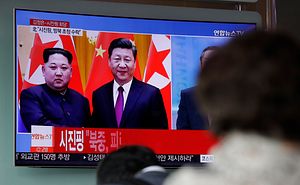
President Trump's team should have annotation of the overriding theme of the Xinhua news agency readout of the historic coming together this week betwixt Chinese President Xi Jinping and Northward Korean leader Kim Jong-un. The Chinese statement emphasized tradition, longevity, and proximity in the statement, underlining that even though a new Kim now reigned in Pyongyang, the relationship betwixt the two countries remains equally close equally ever.
Eleven, nonetheless, is adamant to restore Beijing's influence in Pyongyang — influence that was lost and eroded in the backwash of the 2013 purge of Jang Song-thaek, Kim Jong-united nations's uncle and the erstwhile manager of economic ties between the two countries. Of the 4 proposals that Eleven proffered Kim in Beijing, the first emphasized "high-level exchanges" between the two sides — a tactful acknowledgement on 11's office that Red china would like a amend idea of North Korea's intentions. His second proposal doubles downward on this, by calling to "fill play of the time-tested valuable practices of strategic communication."
To emphasize this in do, it's highly striking how much of the Communist Party of China'due south leadership was in attendance for Kim's visit. Aside from Eleven, Li Keqiang, Wang Qishan, Wang Huning, Wang Yi, Yang Jiechi, and others joined to oversee what Xinhua described as an "unofficial visit." This loftier-level show of attention from the leadership of a fellow nuclear state for Kim not only served to flatter the N Korean leader'due south drive for status in Northeast Asia, but imbued Chinese calls for more frequent high-level contacts with a degree of credibility. Xi, likewise, has accepted an invitation to visit Pyongyang — an opportunity for him to make good on his proposed loftier-level interactions.
Kim, too, brought forth a high-level delegation, bringing in tow Choe Ryong-hae, Kim Yong-chol, Ri Su-yong, Ri Yong-ho, and Pak Kwang-ho. (His sis, Kim Yo-jong, was conspicuously absent — perhaps managing diplomacy back in Pyongyang in his absenteeism.) Kim reportedly told Xi that the purpose of his choosing Beijing as his first destination away was to "carry forwards [the] tradition of DPRK-China friendship." Kim besides made the indicate that he wanted to inform Eleven of developments in his country out of a sense of "moral responsibleness."
Interestingly, the 1961 Friendship Treaty betwixt the two countries — the document that codifies China's only mutual defense obligation — did not appear to come upwardly during this coming together in Beijing. That document has drawn involvement in recent years equally talk of a possible U.Due south. preemptive attack has grown. In runway-II settings and in occasional editorials in nonauthoritative Chinese state media, the treaty is non highly regarded; today'due south interpretation holds that China would honor its defense obligation to Democratic people's republic of korea should Pyongyang face up external assailment, but it won't cutting Kim a bare check to launch an invasion of Due south Korea. Kim and Xi best-selling the treaty'southward 55th anniversary in 2022 and Kim Jong-il, during his last trip to Beijing before his death, likewise made notation of the treaty alongside then-Chinese President Hu Jintao. The absenteeism of whatsoever mention to that document here is curious, indeed.
Of course, the readouts released by both North Korean and Chinese state media have been carefully curated to requite off the appearance of a successful and "comradely" run across in Beijing betwixt these ii leaders. At that place remains the existent possibility that Eleven and Kim constitute areas to agree to disagree. But without whatever prove, we are left merely to speculate.
Past hosting Kim, Xi appears to be making practiced on his promise, delivered during his presentation of the Communist Political party's Political Study during the 19th Party Congress last October, that Prc would never "eat the bitter fruit of harm to its own interests." This is as true on the Korean Peninsula every bit information technology is eleswhere in E Asia, including the East and South Communist china Body of water, where Communist china perceives threats to its territorial integrity and sovereignty. Communist china remains interested in seeing a nuclear weapon-free North korea, but is aware of that a U.S. and Republic of korea-lead diplomatic process could produce an event detrimental to its interests.
With this meeting in Beijing, Xi Jinping has successfully thrust himself into the center of the burgeoning affairs in Northeast Asia around Democratic people's republic of korea's nuclear weapons and ballistic missiles. This process, that began with Kim Jong-un's New year's day's Day address and the ensuing diplomacy in Seoul during the Winter Olympics, remains fragile and has the potential for an unexpected outcome. Communist china'due south continued quest for stability on the Peninsula demands that it avoid becoming a peripheral player every bit South Korea and the The states press on with Pyongyang.
In the meantime as well, we should recall that Chinese and North Korean long-term strategic objectives in Northeast Asia take more in common than not: both Xi and Kim, after all, would welcome the eviction of U.Due south. forces and the U.S. extended nuclear deterrent from South Korea under the guise of the "denuclearization of the Korean Peninsula."
A condensed version of this article appeared in a ChinaFile give-and-take on March 28.
Source: https://thediplomat.com/2018/03/what-trumps-team-need-to-know-about-the-kim-xi-meeting-in-beijing/

Post a Comment for "The Diplomat Xi Meets Kim Again"